What is the Personal Style Indicator?
The Personal Style Indicator is a scientifically developed, self-administered, and self-scored learning and communication instrument. It is not a test that can be passed or failed; it is a tool to help you learn.
The PSI can assist you to do the following.
Identify your basic personal style, which is the way you prefer to respond to time, people, tasks, and situations.
Gain self-understanding and self-acceptance and greater appreciation and acceptance of others.
Recognize the consequences and effect of your interpersonal style and the effect your personal style has on the way you relate to others.
Discover your typical reactions to stress and pressure and learn how to compensate for your weaknesses.
Better understand the style tendencies of others and learn to interact with them more effectively, to promote harmony and increase your credibility.
Increase your productivity and success by sharing a common language when talking with others about the style behaviors that are preferred at home or on a particular job.
Determine your preferred work style and work environment to more intentionally select the best job, role, and/or career for you.
Develop a plan to increase your style-flexibility and effectiveness in relation to tasks and in your interactions with others.
Facilitate team development through the careful assessment of team-member strengths.
Understanding Your Personal Style
We will get to your scores in a minute. First, let’s outline the Personality Development Factors. It will guide you to better understand your own and others’ tendencies and provide increased clarity in self-understanding and improved relationships with others.
Research reveals you are born with a personal style and that it is consistent throughout your lifetime. Your personal style is your natural way to observe, approach, and interact with the environment, which includes time, people, tasks, and situations.
Personal style is only one part of your personality. We must acknowledge that human beings are more complex than just their personal style. Even though it is an important part of your personality, your personal style represents only one facet of you. To simplify and explain this complexity, CRG created the Personality Development Factors Model. (See illustration below.) All these Factors at various levels have and are contributing to your Personality Development. Each factor is self-evident, except perhaps Emotional Anchors, where a past experience of a positive or negative nature stirs an emotional reaction within.
To learn more about the Personality Development Factors Model, buy the book, Why Aren’t You More Like Me? available from CRG.

- Self-Worth levels
- Self-concept: What you think about yourself
- Self-perception
- Identify
- Self-esteem: The way you feel about yourself
- Acceptance of self
- Respect for self
- Self-concept: What you think about yourself
- Biophysical Influences
- Genetics, gender, body type, birth defects
- Biochemical imbalances, addictions
- Health concerns: Allergies, aging
- Personal Style Preferences
- Behavioral ACTION
- Cognitive ANALYSIS
- Interpersonal HARMONY
- Affective EXPRESSION
- Environmental Systems
- Family of origin
- Schools
- Workplace
- Military service
- Society
- Culture
- Nature (climate, geography)
- War zones
- Social Teachers
- Parents and older family members
- Teachers, pastors, coaches, friends, peers, neighbors
- Media personalities: Actors, authors, rock stars, artists, other famous people
- Emotional Anchors
- Negative examples: Divorce, physical and verbal abuse, death of a loved one, failure, moving, job loss, etc.
- Positive examples: A lot of children, a big promotion, winning the lottery, being a hero, etc
You will learn step-by-step how to understand and interpret your scores on the Personal Style Indicator, as you go through the various sections listed below. Style assessment is complex, yet when approached in a systematic manner, it becomes more manageable and offers you a tool for increased clarity in self-understanding and improved relationships with others. Therefore, you will be guided through the following six steps, to better understand your own and others' tendencies
SIX STEPS
- Understanding Personal Style
- Your Personal Style Graph
- Learning about Your General Style Tendencies
- Your Interpretive Summary for Your Style
- Developing Style-Flexibility and Improving Your Credibility
- Designing Your Own Plan to Increase Effectiveness
STEP 1
Understanding Personal Style
Many factors determine your personal style and how much rigidity or flexibility you demonstrate. Your personal style is created by a complex set of behaviors and attitudes that strongly affects the way you present yourself to others. Personal style is your habitual way of behaving or your predisposition to act, in everyday situations, with most people.
Research reveals that you are born with personal style and it is consistent throughout your lifetime. It is your natural predisposition to perceive, approach, and interact with the environment, which includes time, people, tasks, and situations.
Theory and research indicate that four main styles are useful in describing human behavior. Understanding these four styles will provide you with useful insights. It is also important to understand how your personal style underlies much of your behavior.
Personal Style: Your Foundation
Your basic personal style forms the foundation of your interpersonal, communication, parenting, counseling, decision-making, learning, management, preferred job and leadership styles and much more. How you see yourself (self-perception) influences the way you act.
The Personal Style Indicator provides you with an organized view of how you perceive yourself, while also revealing the likely consequences of your style. As you become more keenly aware of those consequences, you can plan to develop greater style-flexibility to increase your effectiveness at home or at work.
The behaviors exhibited by your style vary somewhat from person to person and situation to situation. For the most part and for most people, however, they remain consistent over time.
The general pattern you exhibit is unique and distinct from the patterns of most other people. Gaining deeper understanding of the four style dimensions will assist you to appreciate the characteristics of other styles. You can apply this knowledge later, when you want to adjust your style to be more effective and to build credibility with others.
Style-shifting is an important skill to develop. You can learn to be more flexible and effective without being artificial in the way you present yourself.
Have others complete a PSI on their perception of your style.
If you want an understanding of how others perceive you—both at work and at home—ask them to complete a PSI on you. Over the years we have found this a very insightful process. You can then compare the way you see yourself with the way others see you. This strategy is great for helping interpersonal relationships, team-building, communications, leadership, and other applications. You may also complete the PSI for another person, to help you become more effective with him or her.
Although the PSI should never replace getting to know someone else personally, it can help you frame a way to build credibility and awareness of others’ needs and help you plan your behavior and interactions with others.
Understanding The Four Personal Style Dimensions
48
This style dimension is characterized by a strong tendency toward altering the environment in a way which will achieve well thought-out goals. Therefore, people who naturally operate mainly from this quadrant of style are likely to seem self-assured and driven, many times oblivious to other people's feelings and on a track of their own. When their vision is shared by a group, then they are often seen as heroes and leaders because they tend to forge ahead to meet challenges with unusual fearlessness.
This style position by itself is extroverted and can withstand greater stress. It does not favor artistic, aesthetic or emotional modes of operating, but prefers a planned method by which previously defined goals and results are achieved. In this style there is a clear sense of acting upon the environment to achieve these results.
37
This style dimension is characterized by a strong tendency to avoid being influenced negatively by people or environmental influences. This type moves toward goals which are often perceived as requirements of others in positions of authority. Attention to details and being on the alert for potential dangers or inconsistencies enable people with this style to maintain a better position of security and control. People with this style tend to avoid emotional intensity and unpredictability; and they may especially need intimacy because they find that trust in others is not easily attained.
This style position by itself is introverted, being more sensitive to stimulation. It does not prefer the sensory, emotional modes of operating, but tends toward logical analysis and correct performance of tasks, with an additional interest in the fine arts.
41
This style dimension is characterized by a strong tendency to adapt to people and surroundings in order to promote harmony and comfort for self and others. The approach to life and people in a practical, friendly and naturally warm manner is typical of this style dimension. Adaptation to all other styles is a way of life, providing the desired security and balance needed and preferred by those who score higher in this style dimension.
A desire to support others in order to gain a sense of validation and approval is a natural tendency. This style position by itself is introverted, being more sensitive to stimulation. It favors a practical balance of both the logical and intuitive modes of functioning, thereby avoiding extremes. In this style there can also be a tendency toward stubbornness, especially if others are being overbearing.
34
This style dimension is characterized by a strong tendency to intuitively explore the environment and interact with it to assess the outcome. Spontaneous exploration and expression of ideas and feelings mark the natural tendencies of this style. People with a natural tendency toward this dimension of style are often attempting to influence others through the creative media of speaking, writing, dance, art or music. They would like to sell others on themselves and ideas or products which they believe will be helpful. They will go out of their way to help others, even if it inconveniences them because often they believe in the value of people.
By itself, this style is extroverted, not being easily over-stimulated by the environment. It does not favor the analytical modes of operating, but is more intuitive and creative in its way of functioning.
STEP 2
Your Personal Style Graph
STEP 3
Learning about Your General Style Tendencies
Now you have a visual graph that represents your style pattern. Here is what this might mean to you.
- Each of us has all four dimensions, in varying intensities.
- The higher your score in one of the dimensions, the more likely this dimension is influencing the way you perceive, approach, and interact with the environment.
- The opposite is true for your lower scores. The lower your score in a style dimension, the less likely that dimension is influencing your choices and decision-making.
There is no right or wrong answer or distribution of numbers. The majority of individuals will have two scores above 40 and two scores below 40. Some will have only one score above 40; others will have three scores 40 and above. A small percentage of the population has all four scores within 4 to 5 points.
The combination of your four scores makes up your style pattern. To deepen your understanding of the general style tendencies of each dimension, carefully read the description of each style quadrant to gain an understanding of the general orientation, typical strengths, and common difficulties of each dimension.
We give you permission to personalize this report to your own uniqueness. Ignore the comments that you feel do not apply to you. Identify statements you believe are true about yourself.
Exercising Caution when Assessing Your Own and Others’ Styles
We should never pigeonhole individuals or try to stuff someone into a personality “box.” When provided with crisp, neat categories, the temptation is to use these models as a shortcut for getting to know people. The models were intended to provide clarity and insight about a person’s personality, which is constantly changing, somewhat unpredictable, and often a surprise to even careful observers.
Some people have said of others, “Oh, he's a Cognitive type” or “She’s an Affective type,” pronouncing clear judgment of another person’s personality. This type of simplistic thinking is to be avoided, especially when you share style patterns with friends, co-workers, or family members.
The Personal Style Indicator is just that: an indicator, not a test. It is meant to provide a common language to assist you in understanding your self and in communicating with others regarding the important issue of personal styles.
Understanding Your General Style Tendencies
48
- General Approach:
-
- To tasks:
- wants results now
- To people:
- seeks authority
- To problems:
- tactical, strategic
- To stress:
- doubles efforts
- To time:
- future and present
- Typical Strengths:
- Acts rapidly to get results
Is inventive and productive
Shows endurance under stress
Is driven to achieve goals
Can take authority boldly
- Common Difficulties:
- Can be too forceful or impatient
Can often think their way is best
Can be insensitive to others
Can be manipulative or coercive
Can be lonely or fatigued
37
- General Approach:
-
- To tasks:
- wants quality
- To people:
- seeks security
- To problems:
- analyzes data
- To stress:
- withdraws
- To time:
- past and future
- Typical Strengths:
- Acts cautiously to avoid errors
Engages in critical analysis
Seeks to create a low-stress climate
Wants to insure quality control
Can follow directives and standards
- Common Difficulties:
- Can bog down in details and lose time
Can be too critical or finicky
Can be overly sensitive to feedback
Can seem to be lacking in courage
Can be too self-sufficient, alone
41
- General Approach:
-
- To tasks:
- reliable performance
- To people:
- seeks to help others
- To problems:
- practical solutions
- To stress:
- adjusts to it
- To time:
- present
- Typical Strengths:
- Promotes harmony and balance
Is reliable and consistent
Tries to adapt to stress
Sees the obvious that others miss
Is often easy-going and warm
- Common Difficulties:
- Can be too easy-going and accepting
Can allow others to take advantage
Can become bitter if unappreciated
Can be low in self-worth
Can be too dependent on others
34
- General Approach:
-
- To tasks:
- people come first
- To people:
- seeks to influence
- To problems:
- intuitive and creative
- To stress:
- escapes from it
- To time:
- present and future
- Typical Strengths:
- Acts creatively on intuition
Is sensitive to others' feelings
Is resilient in times of stress
Develops a network of contacts
Is often willing to help others
- Common Difficulties:
- Can lose track of time
Can "overburn" and over-indulge
Can be too talkative
Can lose objectivity, be emotional
Can be self-oriented, self-assured
STEP 4

Your Interpretive Summary for Your Style
Everybody has all four personal style dimensions within them. It is the combination of the intensity levels for the four dimensions which determine the personal style pattern. The pattern represents the overall impact all four dimensions have upon the individual's personality and behavior. It also indicates how naturally flexible you are to “shift” out of one dimension and into another. The combination of dimensional scores determines two different types of patterns, primary and secondary.
How Your Pattern(s) were Determined
The pattern(s) determined for your style have been chosen based on the following rules:
-
All style scores above 40 definitely indicate your preference for style behaviors and tendencies and therefore determine your Primary Style Pattern. The majority of individuals have two dimensions 40 or above. Your scores are ranked by putting your highest score first. Example: if your score is B-55 and I-45, you would read the B & I – Determined profile – and only the Determined profile.
There is, however, one exception—you may have two scores 40 or over within 5 points. Example: Your scores are C-46 and A-44. Because your two scores are within 5 points, you would identify two Interpretive Summaries: C & A – Perceptive and A & C – Inventive. Read them both.
-
Any style scores which are between 35 and 39 should be considered as a dimension of style which you may sometimes prefer. Your Secondary Style Pattern is determined by including all your scores 35 and above.
A percentage of people will have three scores of 40 and over. In this case, one of the Triple-High Patterns will apply. In the case of three dimensions being 40 or over, the order of the letters no longer applies as it did with two dimensions. Example: Your scores are I-46, B-44, C-42 (or I,B,C). You would go to B,C,I – Ambitious. Read this summary because all dimensions are present.
Any style scores that are below 35 definitely indicate your tendency not to prefer behaviors and tendencies typical of those dimensions.
-
Finally, a percentage of individuals will have all four of their scores within 4 to 5 points of each other. Having all your scores within 4 to 5 points means by default that all your scores will be close to the midline of 40. If this is true for you, please go to the very last Interpretive Summary: Synergistic. Example: B - 42, C - 38, I - 41, A - 39 would represent this type of pattern.
Be aware that the main difference between primary and secondary patterns is that when we are under pressure (challenged, stressed out, frightened, etc.) we move to our strengths and away from our weaknesses and moderate strengths. This means you will be affected most by your primary pattern when you are under pressure. The secondary pattern tends to come into play when we feel safe within the environment—when we can relax.
Note: Again, feel free to make this your own personalized report. As you read your interpretations, ignore the interpretive comments that you feel do not apply to you. Identify the comments that describe you most accurately.
Style Summary
Sample Report, Your Primary Pattern
- B & I
- Determined
Because this personal style type has the dominant behavioral tendencies, there is a certain doggedness and persistence in getting things done, even if it takes all day and night. While the interpersonal tendencies in this style take a back seat to the behavioral tendencies, there is a willingness to work with others to accomplish the desired result. They also will tend to the necessary details in this process. These people can display a positive stubbornness when it comes to getting the job done. With the strong dominance factor, human relations are likely to suffer, but not to the extent of the other behavioral styles, due to the softening effects of this personʼs desire for interpersonal harmony as long as the desired results are forthcoming.
Secondary Pattern
- B , C & I
- Ambitious
People with this Personal Style are generally intense, highly motivated people who are also conscientious and dependable. Complex and somewhat unpredictable, they may tend to push toward their goals, be concerned about producing high quality, and also show concern for the welfare and morale of others. They tend to get results by combining analysis with practicality. They are often concerned that others will fall below their own standards. They can be so motivated to improve things that others admire their ambition and their drive for accomplishments and, at the same time, potentially feel intimidated, overwhelmed, or even jealous of their energy, drive, and creativity.
In-Depth Interpretations
Sample Report, Your In-Depth Interpretation
- B & I
- Determined
Primary Pattern
- Strengths
- This style has a unique combination. People with this style possess a strong natural orientation toward seeking action combined with a marked tendency toward being friendly with others. These people get their results by being friendly, reliable, persistent and hardworking. Like many dentists, machinists and researchers, these people seem to be working on a number of projects simultaneously. You can count on them to be reliable workers with well-thought-out goals and step-by-step plans. It is important for people like this, who score high in the Interpersonal dimension, to create harmony in their dealings with people and within the physical environments that surround them. Therefore, we would expect to find them having fairly stable careers and generally being pleasant and polite on the job. While they will enjoy chatting with co-workers, they are also concerned to get back-to-business shortly so that tasks are finished on time. The determined person tends to have lists of things that have to be done and checked off. Although the strong influence of the Interpersonal dimension helps to stabilize and balance any danger of seeking results-at-any-cost whatsoever, the most dominant tendency in this pattern is the desire to achieve completion of an activity and to secure a result.
- Common Difficulties
- Being systematic, organized and clearly focused, the determined style tends toward impatience with others who aren’t as industrious and task-oriented. Determined people can be brisk and too busy for a variety of friendships or easy-going relationships. They don’t seem to need people as much as they need to be busy getting concrete results at some activity or project that fits into their long-range plans for career and life fulfillment. They can be so preoccupied with themselves and their ambitions that they tend to do their own thing at the expense of family or corporate goals. They can get extremely frustrated if things or people get in the way or thwart their plans, which can cause them to blow up at times or criticize others in a fit of frustration (unless their Interpersonal dimension moves in to restore harmony). They can be so mentally preoccupied with their own agendas or checklists that they fail to notice what is happening around them, and, quite unintentionally, fail to even hear the content of what others are saying.
- Reactions to Stress
- There is a tendency to withdraw and become non verbal when others aren’t meeting the performance standards that the determined people expect. Their reaction is often to take over a project and attempt to shoulder all the responsibility for its completion rather than talking about what is bothering them. These people want things done properly and aren’t easily distracted from getting the right results. Once they get up a head of steam they don’t want to lose their momentum. Consistency and predictability of expected results are their highest priorities. When their priorities and goals are threatened, these people’s energies become quickly focused on returning things to normal. These styles of people often say, “I just can’t rest until I get this thing done.”
- Team Functioning and Compatibility with Other Styles
- This style tends to be willing to function on a team when he or she can be in control, when the agendas are clear and where standards of performance are well established for each team member. The determined person runs a tight ship and wants others to get the job done quickly and in a reliable manner, but is not rigidly perfectionistic. This style is a “systems” person, who likes things to be organized into effective and efficient procedures. They prefer things to be organized already by others so that they just need to follow the rules. The driving and non-communicative characteristics of this style have to be kept in check or team members may withdraw and quietly or even openly confront them. In families, this style of person can adapt to both the authoritative and affectionate roles involved, and usually are fair in how he or she tends to interact with all who are involved. This style prefers to work with Cognitive styles because of their carefulness and attention to detail. They also prefer working with the Interpersonal styles because of their pleasantness and tendency to follow. The Affective styles are not usually favored by this style because of the seeming lack of orderliness and logic in these people’s approach to problems and to life in general. They often admire other strong Behavioral styles who get things done but can have difficulties with the Affective styles who aren’t accomplishing their tasks, especially when those tasks interfere with the determined person’s tasks and schedules.
- Leadership Implications
- In leadership positions, where development of team spirit and achievement of preset targets are very important, these styles of people are perhaps the most naturally suited of the four Behavioral action style patterns. They are concerned about the practical issues of reaching concrete goals and yet, with some effort, can attend to the interpersonal aspects of encouraging others to do their best. They are often quite sociable, promoting a pleasant atmosphere in the workplace. They also make good managers, especially where the attainment of concrete performance objectives is the primary role of their positions. They are good listeners when they are not over focused on urgent task completion. And they have a very strong tendency to think before moving ahead and do not overreact to problem situations “just to be doing something.”
- To Increase Effectiveness
- Although this style has the least risk of burnout among the Behavioral action patterns, care should still be taken to slow down. Before starting out to meet the next challenge, they should take time to smell the flowers, to go for a walk, to just be still, to pray, to exercise, or to go for a hike in nature. Playing with their children can be refreshing and surprisingly therapeutic. Because people with this style often have clear goals and expectations of how things should turn out, they could also improve their effectiveness by drawing more upon the right side of their brains: by learning to be more creative and intuitive in their approach—to do more lateral instead of linear thinking. They need to reflect on ways in which things could be redesigned and improved, rather than just on how things can be completed. Though harmony in personal relationships and pleasantness in their environments is important to determined people, they still tend toward taking action to secure results both in business and in their relations with others. It would be an asset for these people to develop improved communication with the people around them and to practice it on a regular basis. They could benefit from being more successful at sharing feelings, viewpoints and values with others. Reading a book on interpersonal communication may not be enough of a stimulus to create a change in their behavior. They would benefit most from taking courses where coaching in how to deal with different real-life situations is available. To minimize conflict in their lives, determined style people should do all they can do to ensure that those with whom they live and work are willing and able to support them in reaching their goals. They often have a difficult time tolerating inefficiency in others, so working with others who are competent will create a more harmonious work or family environment. They also need others to show appreciation for all their overtime efforts. Providing clear and frequent positive feedback will go a long way with this style of individual.
- B , C & I
- Ambitious
Secondary Pattern
- Strengths
- People with this pattern have so much mental energy and personal drive that they are often coming up with new ideas, inventing new products or designing new ways to improve systems. No matter what type of work they are in, they tend to be individualists who like to take over a territory and be responsible for it all by themselves. They can be so astute, clear-minded and practical in their approaches to problems that others often seek them out for advice in their areas of expertise. You can count on these individuals to take on a project, to complete it on time and to hold themselves accountable for achieving a high standard of performance.
- Common Difficulties
- These people often tend to be so preoccupied with their own concerns that others can feel ignored or taken for granted. They are so preoccupied with getting tasks done and achieving successful results that there isn’t much room left in their lives for building and maintaining close personal relationships. They seem too busy to finish a conversation or to get to know people well. They want to know that family, friends or co-workers are happy and want to assist them in any way they can. Unfortunately, they find it hard to make enough time in their lives to do this. The Interpersonal tendencies in this pattern are in constant competition with the Behavioral and Cognitive tendencies. It is as though there is a willingness to be concerned for others, but not a preference toward spending enough of the time required to attend to the well being of others and to address their needs.
- Reactions to Stress
- Under stress, ambitious people can see others as obstacles to solving problems quickly and can often perceive others to be the major part of a problem that is causing them stress. Consequently, there is a tendency for individuals with this personal style pattern to want to withdraw from others during times of stress. When this occurs, ambitious people will redouble their efforts and exclude others from providing any help. They rely on their own resources to complete the task by themselves, believing that other people will slow them down or get in the way. It is often these people’s striving for success, however, that leads to a serious build-up of stress over time. Being so independently minded, they may ignore the adverse effects on their health or decline offers of help from other people. They prefer to work things out on their own rather than depend on any crutches. As a result, they can withdraw from people close to them at precisely the times when they should be drawing on these family members, friends or business associates for assistance.
- Team Functioning and Compatibility with Other Styles
- Since these individuals can be so intensely concerned with reaching their own goals, they tend to become frustrated on a team with the often time-consuming process of working with others, especially with people who may not be as competent, motivated or professional as they are. People with this personal style prefer to have projects delegated to them alone so they can take the ball and run with it until the job is finished. They may dislike having to share ideas or efforts. In personal relationships, they tend to be attracted to the more Affective and Interpersonal styles because these people’s traits not only complement their own style tendencies but also tend to challenge their shortcomings. Ambitious people are likely to be committed to achieving personal growth and success. They will likely take full advantage of a highly intimate relationship with a partner to promote mutual growth and understanding. In relationships where their partners permit them enough independence and tolerate their frequent spurts of intense energetic activity, people with this style can be thoughtful, loyal and dependable in return.
- Leadership Implications
- Usually, they are more interested in being team leaders than team members. They prefer to delegate to subordinates those parts of a project they are sure others can handle, but at the same time they like to maintain tight control over the final outcome of the project themselves. When other team members are skilled and competent, people of this style can make good leaders because of their strong natural tendency for desiring high-quality results. They are also willing to give responsibility to others and to show consideration for other people’s well being and morale. If they could learn to be more expressive of their feelings and to draw more upon their creative and intuitive abilities, they could probably increase their leadership effectiveness significantly. Without this added style flexibility, they tend to be better at managing tasks or functions within existing systems rather than rallying others to pursue new directions. They can have difficulty infecting other people with their enthusiasm and drive.
- To Increase Effectiveness
- The key area for this style is to focus on improving performance with others—whether at home or at work—by developing their interpersonal communication. While this person is fundamentally a mixture of introversion and extroversion, he or she tends to prefer activities associated with left-brain dominance (for example, logical or analytical reasoning) and so efforts should be expended toward developing the intuitive and expressive tendencies of the Affective dimension to increase style flexibility. To be able to show emotion more naturally and comfortably would help ambitious people improve their human relations. Others would then be more likely to understand them better, to know how they feel and to know what they would like other people to do for them. Assertiveness training is another avenue worth pursuing to develop improved interpersonal skills. This is especially true for people with this style pattern who can alternate from being passive one moment to being aggressive the next, over fairly short periods of time, depending upon the situation. Other people can find these mood swings to be disconcerting. Those with this personal style can learn to relax more by learning how to better manage and release stress. In addition, since these people can be too time-conscious, they need to schedule perhaps a few hours every so often where there is no goal to reach, no deadline to meet and no job to be done. At first, this lack of activity might irritate them because it may seem like laziness or a waste of time but there is often a need to slow down the seemingly incessant mental activity of these styles of people so they can relax for a change. This will assist them to overcome their tendency toward overworking and to increase their enjoyment of life.
STEP 5

Developing Style-Flexibility and Improving Your Credibility
After you are able to recognize behavioral style patterns in your own and in others' behaviors, you will be better prepared to develop your social awareness and versatility. Each of us already has a capacity for a certain amount of flexible behavior toward another person, depending on the needs of the moment. The further development of your awareness of self and others will allow you greater freedom to be more intentional and conscious in your dealings with others, for your benefit and theirs.
Style-Matching to Avoid Style-Clashing
We can clash with others just by virtue of our natures. People naturally get along with some people better than others. Those people with whom we have style clashes can be respected and valued more if we are willing and able to shift into behavioral patterns with which they are more comfortable. This is not to say we should stop being ourselves, but that we can learn to be ourselves in ways that are more effective in adapting to others' styles. This creates a more favorable climate for problem-solving and relationship development.
Style-Shifting Guidelines
The diagram below illustrates the five steps for effective style-shifting. These guidelines can assist you in being more aware of how you might behave differently with different types of people who, in various situations, exhibit and prefer various types of behavior from yours.
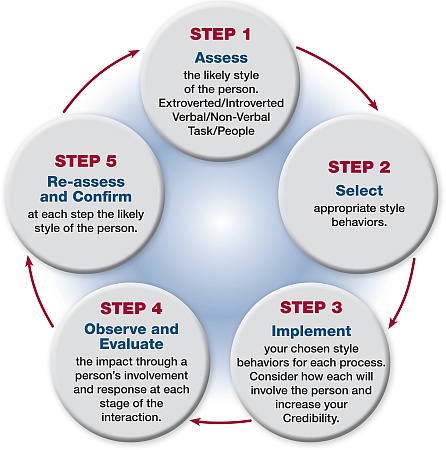
- Step One
- Access the style of the other person
- Step Two
- Select appropriate style behaviors
- Step Three
- Implement your new style behaviors
- Step Four
- Observe and evaluate the impact
- Step Five
- Re-assess and repeat, if necessary
Style-Shifting Guidelines
48
Give them summarized facts
Respect their judgments
Support them to reach goals
Cope with unwanted details
Cooperate with them
Get most upset when others:
Are too slow
Get in their way
Talk too much
Try to be in control
Waste time
Respond best to:
Direct, honest confrontations
Logical, rational arguments
Fair, open competition
An impersonal approach
Getting results quickly
37
Give them detailed information
Ask for their opinions
Not interrupt their work
Treat them with respect
Do quality work the first time
Get most upset when others:
Move ahead too quickly
Don't give them enough time
Are vague in their communications
Don't appreciate their efforts
Are too personal or emotional
Respond best to:
Diplomatic, factual challenges
Arguments based on known facts
Freedom from competitive strain
Friendliness, not personal contact
Doing tasks well and completely
41
Make them feel like they belong
Appreciate them for their efforts
Be kind, considerate, thoughtful
Trust them with important tasks
Value them as persons
Get most upset when others:
Get angry, blow up, or are mean
Demand that they physically move
Take advantage of their goodness
Are manipulative or unfair
Are judgmental of others
Respond best to:
A gradual approach to being challenged
A factual, practical approach
Comfortable, friendly times
Respecting their boundaries
Conventional, established ways
34
Give them opportunity to speak
Admire their achievements
Be influenced in some ways
Take care of details for them
Value their opinions
Get most upset when others:
Are too task-oriented
Confine them to one place
Are not interested in them
Compete for and win attention
Seem judgmental of them
Respond best to:
Being challenged in a kind way
An influencing, sales approach
Enjoyable competitions
Affection and personal contact
Having a good time
STEP 6
Designing Your Own Plan to Increase Effectiveness
The outline below provides you with an opportunity to briefly summarize what you have learned about yourself through the Personal Style Indicator.
Write your responses in the sections below
The Main Strengths Of My Style Are:
The Main Difficulties With My Style Are:
What I Could Do To Become More Flexible In Certain Areas:
Behaviors I Would Like To Have More Control Over:
What I Could Do To Be More Effective With Certain People (think of specific people and read Style-Shifting Guidelines from previous page):


Publisher's Note
Research has confirmed that your (our) Self-Awareness is the secret ingredient (meta-skill) for success in the 21st century. People who understand who they are—and how they’re seen—make smarter choices, build positive relationships, enjoy more successful careers, feel more fulfilled and live better lives.
Without this book, you have only scraped the surface of understanding personal style. Would you like to know more about style and how you can use it to improve your life, relations and interactions with others?
https://crgleader.com/product/why-arent-you-more-like-me/
Discover the foundation of personal and professional success!
The Why Aren’t You More Like Me? eCourse is designed to show you exactly how to improve your life through mastering your self-awareness!
Learn how to improve your life, relationships, and interactions with others.
https://crgleader.com/why-arent-you-more-like-me/
CRG’s Purpose is to Help Others Live, Lead, and Work On Purpose! Access our services and expertise to improve your condition and performance through the approach or methodology that is most appropriate to realize your objectives. Take advantage of our free library of information in various formats to help serve and develop you. For more information:
